There is a new major effort to combat the Religious Right that is trying to be respectful of spiritual belief, yet sharply critical of Dominionism and Theocracy.
Launched only a few days ago, the website is a combination resource center and blog that proclaims:
"The Campaign to Defend the Constitution combats the growing influence of the religious right over American democracy, education, and scientific progress and leadership."
As one post explained:
"We are dealing with a powerful group driven by a specific agenda, who seek to control many different facets of our culture. As their power has grown, the religious right has alienated, frightened, or infuriated millions of Americans along the way. DefCon is here to unite these Americans. Regardless of what drove you to fight the religious right, it is imperative we realize that advancements of their agenda anywhere increase their power everywhere."
DefCon has already sent a letter to all 50 governors urging them to "keep science curricula based on science, not religious rhetoric." The group has published "Islands of Ignorance: The Top 10 Places Where Science Education is Under Threat."
Everyone concerned about the Religious Right, defending the Constitution, and respecting separation of religion and state should log on, join the debate, and make a donation. I plan to do all three.
OK, so I seem to be contradicting my last post. But when a new idea comes along that changes reality, I get to change my tune.
DefCon: Campaign to Defend the Constitution
Post comments at: Talk2Action
Friday, September 30, 2005
Monday, September 12, 2005
Democrats, Religion, and Rhetoric
Less than a third of Americans think the Democratic Party is friendly toward religion. According to a Pew Research Center poll conducted in July of 2005, only 29% of those surveyed thought Democrats were “religion-friendly;” down from 40% in 2004. More than half of those surveyed--55%--thought the Republicans were friendly toward religion.
At the same time, 45% of those polled thought that “religious conservatives” had too much control over the Republican Party, while 44% thought that “non-religious liberals” had too much control over the Democratic Party.
These results can be interpreted in many ways, but I think they show that the Democratic Party and its allies need to spend more time thinking about how the average American perceives their attitude toward religion. In reality, millions of people of faith are loyal Democrats. In the past few years, however, many Democratic Party leaders have demonstrated their inability to discuss religion, politics, and the Christian Right using language that teaches rather than trashes. Every week I get postal mail and e-mail solicitations for donations that use demonizing buzz phrases such as “Radical Religious Right,” or “Religious Political Extremist.” That type of rhetoric may scare some people into writing checks in the short run, but it makes it harder in the long run for grassroots organizers to build a broad-based movement for social change that includes people in progressive, liberal, and centrist religious groups.
I do worry about the Christian Right. I worry about separation of church and state. I worry about theocracy and the tendency toward Dominionism that leads some in the Christian Right to seek a form of Christian nationalism that would rewrite Consitutional protections for those with whom they disagree or see as sinful. Frankly, George W. Bush scares me. He owes the Christian Right a bunch of political favors for their electoral support, and he has been delivering.
Most Christian evangelicals, however, are not part of the Christian Right. I know from talking with evangelicals and fundamentalists across the country that they are offended by the rhetoric from some liberal and Democratic Party leaders who do not seem to be able to talk about religion without chewing on their foot.
I have this fantasy about kidnapping a busload of liberal inside-the-beltway pundits and driving them to some town in Middle America where they have to learn how to talk to voters who think that going to a church, or synagogue, or mosque or other place of worship is a normal part of life. The pundits won’t be given a ticket back to Dupont Circle until they don’t flinch when someone says words like “faith,” “prayer,” or “blessing.”
I suspect some will have to walk back to the Potomac.
Like I said, it’s just a fantasy, but rhetoric is important. If we are to change the perception that Democrats are not friendly to religion, then a good first step is changing language that is offensive.
Post comments at: Talk2Action
At the same time, 45% of those polled thought that “religious conservatives” had too much control over the Republican Party, while 44% thought that “non-religious liberals” had too much control over the Democratic Party.
These results can be interpreted in many ways, but I think they show that the Democratic Party and its allies need to spend more time thinking about how the average American perceives their attitude toward religion. In reality, millions of people of faith are loyal Democrats. In the past few years, however, many Democratic Party leaders have demonstrated their inability to discuss religion, politics, and the Christian Right using language that teaches rather than trashes. Every week I get postal mail and e-mail solicitations for donations that use demonizing buzz phrases such as “Radical Religious Right,” or “Religious Political Extremist.” That type of rhetoric may scare some people into writing checks in the short run, but it makes it harder in the long run for grassroots organizers to build a broad-based movement for social change that includes people in progressive, liberal, and centrist religious groups.
I do worry about the Christian Right. I worry about separation of church and state. I worry about theocracy and the tendency toward Dominionism that leads some in the Christian Right to seek a form of Christian nationalism that would rewrite Consitutional protections for those with whom they disagree or see as sinful. Frankly, George W. Bush scares me. He owes the Christian Right a bunch of political favors for their electoral support, and he has been delivering.
Most Christian evangelicals, however, are not part of the Christian Right. I know from talking with evangelicals and fundamentalists across the country that they are offended by the rhetoric from some liberal and Democratic Party leaders who do not seem to be able to talk about religion without chewing on their foot.
I have this fantasy about kidnapping a busload of liberal inside-the-beltway pundits and driving them to some town in Middle America where they have to learn how to talk to voters who think that going to a church, or synagogue, or mosque or other place of worship is a normal part of life. The pundits won’t be given a ticket back to Dupont Circle until they don’t flinch when someone says words like “faith,” “prayer,” or “blessing.”
I suspect some will have to walk back to the Potomac.
Like I said, it’s just a fantasy, but rhetoric is important. If we are to change the perception that Democrats are not friendly to religion, then a good first step is changing language that is offensive.
Post comments at: Talk2Action


Thursday, July 21, 2005
Sacred Text, Progressive Voices
Back in late 1960s and early 1970s I was part of a group of young adults who ran an ecumenical conference for youth concerned about social justice. It was held at a Protestant retreat center on Lake Winnipesaukee in New Hampshire.

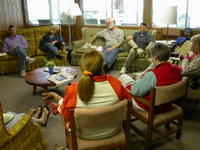
Some years ago a group of us returned for a reunion, and now we continue to gather every few years to renew our commitment to social justice and to search for ways in which secular ethics and spirituality can co-exist in these turbulent times.
This summer we decided to read a book for discussion, and we picked The Sins of Scripture: Exposing the Bible’s Texts of Hate to Reveal the God of Love, written by Episcopal Bishop John Shelby Spong. When it came my turn to pick some text to discuss, this is what I selected:
For some people this represents the entire history of Christianity—and given this history, I am not surprised when people ask me why I consider myself a Christian. I usually toss off a glib line such as “I am unchurched but not uncouth.” What I mean by saying that phrase is the limits and flaws of all organized religions frustrate me, but I see in each a struggle for the identity of the faith. The lessons I learned from the Christian Bible were about helping the weak and the poor, seeking justice, opposing violence and war, speaking truth to power—all of which led me into the progressive movement. Moreover, I learned to highlight a different history of Christianity based on this perspective. As I learned more about the sacred texts of other major world religions, I came to realize that some members of those faiths highlighted these same concerns. They challenge those in their religion who turn toward demonization and scapegoating.
Spong explains that these different approaches derive from the fact that there are different ways to read sacred text. Peter J. Gomes, a preacher at Harvard University and author of The Good Book: Reading the Bible with Mind and Heart makes a similar argument. Gomes urges us to read the Bible carefully and be aware of what passages represent the contemporary prejudices and norms woven into the text by the all-to-human authors.
Rosemary Radford Ruether, author of several books, explores the need to unpack these prejudices when examining spirituality. She uses an analysis of race, class, and gender that sees them as “interconnected structures that create multiple differences.” The group Equal Partners in Faith is built around this notion.
In the past few weeks, there has been a flurry of media coverage declaring that progressive Christians have finally found their voice. We have had our voices all along, thank you. Glad you folks in the media finally decided to listen.
Post comments at: Talk2Action

Some years ago a group of us returned for a reunion, and now we continue to gather every few years to renew our commitment to social justice and to search for ways in which secular ethics and spirituality can co-exist in these turbulent times.
This summer we decided to read a book for discussion, and we picked The Sins of Scripture: Exposing the Bible’s Texts of Hate to Reveal the God of Love, written by Episcopal Bishop John Shelby Spong. When it came my turn to pick some text to discuss, this is what I selected:
"Anxious because God could not be reduced to a human formula, the leaders of the church contented themselves with the task of enforcing the faith they could not define. If one disagreed with these ever-more-differing explanations, one was simply evil. The problem was not in the words; it was in the hardened hearts of the heretics whose obstinacy and sinfulness prevented them from believing. The stage was thus set not for unity but for a purge. Whenever deviant beliefs were discovered, they had to be rooted out and those who espoused them killed in the service of conformity to the catholic faith. So Christianity turned demonic. Infidels like the Jews were constantly persecuted and Muslims as well as Jews were killed in the Crusades. Heretics were burned at the stake. Religious wars were waged to defeat anyone who did not worship properly. Efforts to force people to conform were accomplished by way of torture first and if that failed by execution" (Spong, p. 228).
For some people this represents the entire history of Christianity—and given this history, I am not surprised when people ask me why I consider myself a Christian. I usually toss off a glib line such as “I am unchurched but not uncouth.” What I mean by saying that phrase is the limits and flaws of all organized religions frustrate me, but I see in each a struggle for the identity of the faith. The lessons I learned from the Christian Bible were about helping the weak and the poor, seeking justice, opposing violence and war, speaking truth to power—all of which led me into the progressive movement. Moreover, I learned to highlight a different history of Christianity based on this perspective. As I learned more about the sacred texts of other major world religions, I came to realize that some members of those faiths highlighted these same concerns. They challenge those in their religion who turn toward demonization and scapegoating.
Spong explains that these different approaches derive from the fact that there are different ways to read sacred text. Peter J. Gomes, a preacher at Harvard University and author of The Good Book: Reading the Bible with Mind and Heart makes a similar argument. Gomes urges us to read the Bible carefully and be aware of what passages represent the contemporary prejudices and norms woven into the text by the all-to-human authors.
Rosemary Radford Ruether, author of several books, explores the need to unpack these prejudices when examining spirituality. She uses an analysis of race, class, and gender that sees them as “interconnected structures that create multiple differences.” The group Equal Partners in Faith is built around this notion.
In the past few weeks, there has been a flurry of media coverage declaring that progressive Christians have finally found their voice. We have had our voices all along, thank you. Glad you folks in the media finally decided to listen.
Post comments at: Talk2Action
Friday, July 01, 2005
Making Distinctions - Seeing Possibilities
We have learned a few things at Political Research Associates (PRA) over the past 24 years of studying U.S. right-wing political and social movements, and we have captured our best advice in a document titled "Ground Rules and Tips for Challenging the Right." There are three sections--Do Your Homework, Stay Cool in Public, and Keep Organizing--each with several suggestions.
When PRA staff speak in public we often expand on these recommendations, and a blog seems like a good place to enshrine these musings in written form. Over the next few months, I will pick one suggestion and write a short essay around it, with some useful links if I can find them.
To start, let’s look at the following recommendation:
Distinguish between leaders and followers in right-wing organizations.
Leaders are often “professional” right-wingers. They’ve made a career of promoting a rightist agenda and attacking progressives and progressive issues. Followers, on the other hand, may not be well-informed. They are often mobilized by fears about family and future based on information that, if true, would indeed be frightening. This so-called “education” is often skillful, deceitful, and convincing. These followers may take positions that are more extreme than those of the leaders, but on the other hand, they may not know exactly what they are supporting by attending a certain organization’s rally or conference. To critique and expose the leaders of right-wing organizations is the work of a good progressive organizer, writer or activist. In the case of the followers, however, it is important to reserve judgment and listen to their grievances. Do not assume that they are all sophisticated political agents or have access to a variety of information sources.
--
PublicEye.org - Ground Rules and Tips for Challenging the Right
This does not mean that we should think that followers are dimwitted, ignorant, or crazy. That was a common perception promoted by centrist academics during the 1960s, but since the late 1970s sociologists have shown that people who join social movements--left or right--are remarkably similar to the population from which they emerge. And people in social movements are not mesmerized by crafty leaders, cluelessly following the whims of charismatic demagogues. Demagogues exist, to be sure, but they primarily succeed by swaying large groups of people by developing clever ways to frame ideas and issues.
Frames are necessary but not sufficient to build a movement, but frames are an important tool.
That's good news for progressives who want to mobilize a counter-movement. We can examine the frames put forward by the Hard Right and devise alternative frames that drive wedges between specific constituencies. We can do that with topical analysis, for example exploiting the tension between Christian conservatives and libertarians on social issues such as abortion and gay rights. And we can recognize that participants have different levels of commitment and loyalty to social movements.
Letha Dawson Scanzoni has produced a useful set of distinctions that explain this in her AlterNet article The Gospel On Gay Marriage
Aggressive Combatants, who mobilize their followers to go to battle against whatever they consider to be the current threat (most recently, same-sex marriage);
Loyal Followers, who consider the Combatants to be their religious authorities, buying their books, tuning in to their broadcasts, accepting their interpretations of the Bible, and responding to their fundraising pleas;
Thoughtful Questioners, who were drawn to the movement by its emphasis on a personal relationship with God and the importance of the Bible in their lives but are not convinced that all issues are settled or that all the answers are already in;
Hurting Strugglers, sincere believers who earnestly practiced their faith and followed the rules they had been taught, yet were faced with some circumstance that turned their well-ordered world upside down -- a divorce, a gay child, a pregnant teenager, domestic violence, mental illness, job loss, bankruptcy, a suicide in the family.
These are useful names for important distinctions. As Scanzoni observes, we should be focusing our attention of the last two categories: Thoughtful Questioners and Hurting Strugglers, because they are already in a place where new ideas and new frames have a better chance of finding fertile soil.
I happen to think that a commitment to the idea of civil society means we should be treating people with sincere spiritual belief systems with courtesy and respect--just as I think we should be treating secular ethical and moral belief systems with courtesy and respect. In this case, there are hardball pragmatic reasons to be able to talk with Christian conservatives about moral values…we just might change their minds.
Post comments at: Talk2Action